Baghouse filter bags
Eight needle felt media, one construction standard. Whether you are replacing 60 bags on a clinic incinerator or 2,000 on a coal boiler, the specification starts with your gas temperature and chemistry — not with whatever is in stock.
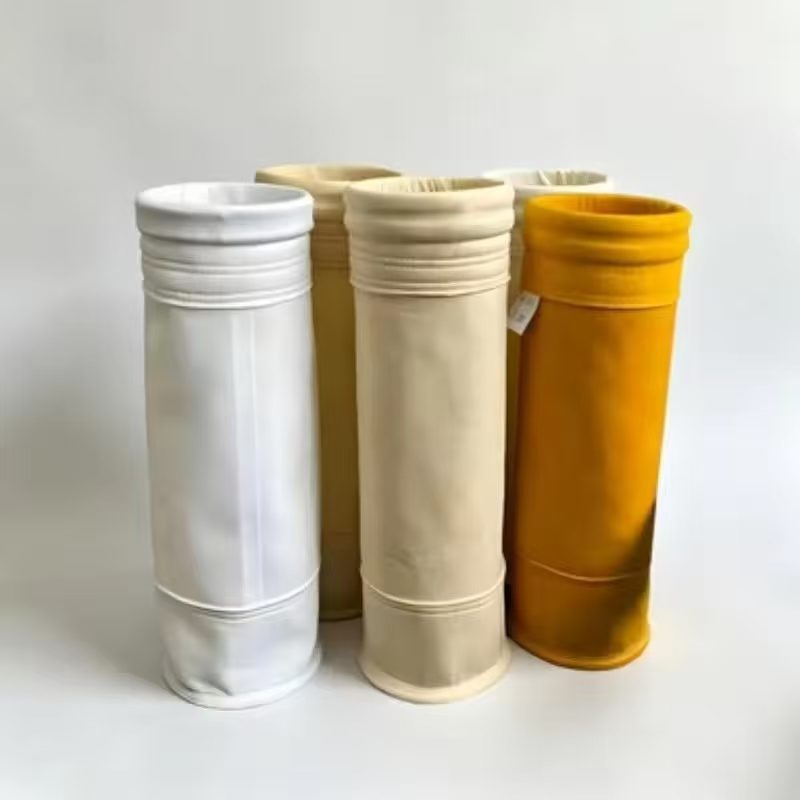
Material comparison
Continuous service temperature is the headline number, but it is rarely the number that decides bag life. Read across the chemical columns too.
| Media | Continuous | Peak | Acid | Alkali | Hydrolysis | Oxidation | Abrasion | Best for |
|---|---|---|---|---|---|---|---|---|
| Polyester (PE) | 130 °C | 150 °C | Good | Fair | Fair | Good | Excellent | General dry dust, cement, wood, food |
| Acrylic (AC) | 140 °C | 150 °C | Good | Poor | Excellent | Fair | Fair | Moisture-laden gas, asphalt dryer |
| PPS (Ryton type) | 170 °C | 190 °C | Excellent | Excellent | Good | Poor | Good | Coal boilers, waste incineration, acid flue gas |
| Aramid (Nomex type) | 200 °C | 220 °C | Fair | Fair | Poor | Fair | Excellent | Hot dry dust, foundry, cement kiln |
| Polyimide (P84) | 240 °C | 260 °C | Fair | Poor | Fair | Good | Fair | High temperature with fine dust |
| PTFE | 260 °C | 280 °C | Excellent | Excellent | Excellent | Excellent | Fair | Chemically aggressive or wet gas |
| Fibreglass | 260 °C | 300 °C | Fair | Fair | Good | Excellent | Fair | Very high temperature, dry gas |
| Anti-static PE | 130 °C | 150 °C | Good | Fair | Good | Good | Excellent | Explosive dust, coal handling, grain |
Values are typical industry figures for needle felt at 450–600 g/m². Actual performance depends on gas composition, filtration velocity and cleaning regime — confirm with a sample test on critical applications.
Construction options
Media choice gets the attention; construction is where bags quietly fail. Every option below is confirmed on a drawing before production.
Bag body
- Round bags from 100 mm to 200 mm diameter, length up to 8,000 mm
- Weight 450–600 g/m² depending on media and finish
- Double-stitched seams with PTFE or fibreglass thread
- Anti-collapse rings or wire support on request
- Reinforced bottom disc, or flat bottom for reverse pulse
Top fixing
- Snap band — fastest to fit, most common on pulse jet collectors
- Clamp collar — higher holding force, suits larger diameters
- Rope cuff / strap — for older or non-standard tube sheets
- Flange and ring — pleated cartridges and special housings
Finishes
- Singed (surface fibre burnt off for cleaner dust release)
- Calendered (smooth surface, lower initial efficiency)
- PTFE membrane laminated — surface filtration from day one, near-zero emission on fine dust
- PTFE impregnation for acid and moisture resistance
- Water and oil repellent treatment
- Anti-static conductive fibre grid
Documentation
- Bag drawing with all dimensions for your confirmation
- Material certificate and batch number on the packing list
- Packed in bales with moisture barrier, export carton or pallet
- Sample bags available before a full order
Getting the size right
Measure the bag, not the cage, and measure a bag that has been in service — new bags are shorter than installed bags on most pulse jet collectors because the fabric stretches under tension.
A practical shortcut: give us the tube sheet hole diameter, the cage length and the number of bags. From those three numbers we can normally build the drawing without asking you to remove a bag.
- Diameter measured across the bag body, not the cuff
- Length from the top fixing point to the bottom disc
- Note any taper, anti-collapse rings or special cuff
Filtration velocity guide
| Dust type | Air-to-cloth |
|---|---|
| Incinerator fly ash (with membrane) | 0.7–1.0 m/min |
| Coal boiler fly ash | 0.9–1.2 m/min |
| Cement mill / kiln | 0.8–1.1 m/min |
| Asphalt dryer | 1.2–1.5 m/min |
| Woodworking, general ventilation | 1.5–2.0 m/min |
Lower velocity means longer bag life but a bigger collector. On medical waste incinerators, stay at the low end.
Frequently asked
- Which bag do I need for a medical waste incinerator?
- Usually PPS with a PTFE membrane up to about 170 °C, or PTFE felt where the gas is wetter, more acidic, or runs hotter. Do not fit standard polyester: the combination of HCl, SO₂ and moisture hydrolyses it quickly. If your unit runs a dry scrubber and a heat exchanger ahead of the baghouse, PPS is normally sufficient.
- What is the minimum order quantity?
- There is no fixed minimum — small replacement sets are shipped by air courier all the time. Price per bag simply improves with quantity and with a repeatable specification.
- Can you match a bag I already have?
- Yes. Send a photo of the bag with a tape measure against the length, and the bag top and bottom detail. We produce to the drawing and send it for your confirmation before cutting.
- Do you supply the cages?
- Yes, galvanised or stainless steel cages to match the bag, though most customers only need bags.
- Is a PTFE membrane worth the extra cost?
- On fine ash below 10 µm, usually yes: it filters at the surface instead of inside the felt, which lowers pressure drop and improves capture of sub-micron particles. On coarse dust it adds cost without much benefit.
- How are bags packed for export?
- Compressed bales wrapped in moisture barrier film, then carton or pallet. Bags stay compressed in transit, which is normal; they recover after fitting.
Not sure which media?
Send the gas temperature, the dust source and the bag size. We will tell you which of the eight media fits, and which limits to watch.