Small medical waste incinerators
Two-chamber units for hospitals, clinics, laboratories and regional treatment centres. Sized by your daily waste weight, with a secondary chamber held at 1100–1200 °C and a gas residence time of at least 2.0 seconds.
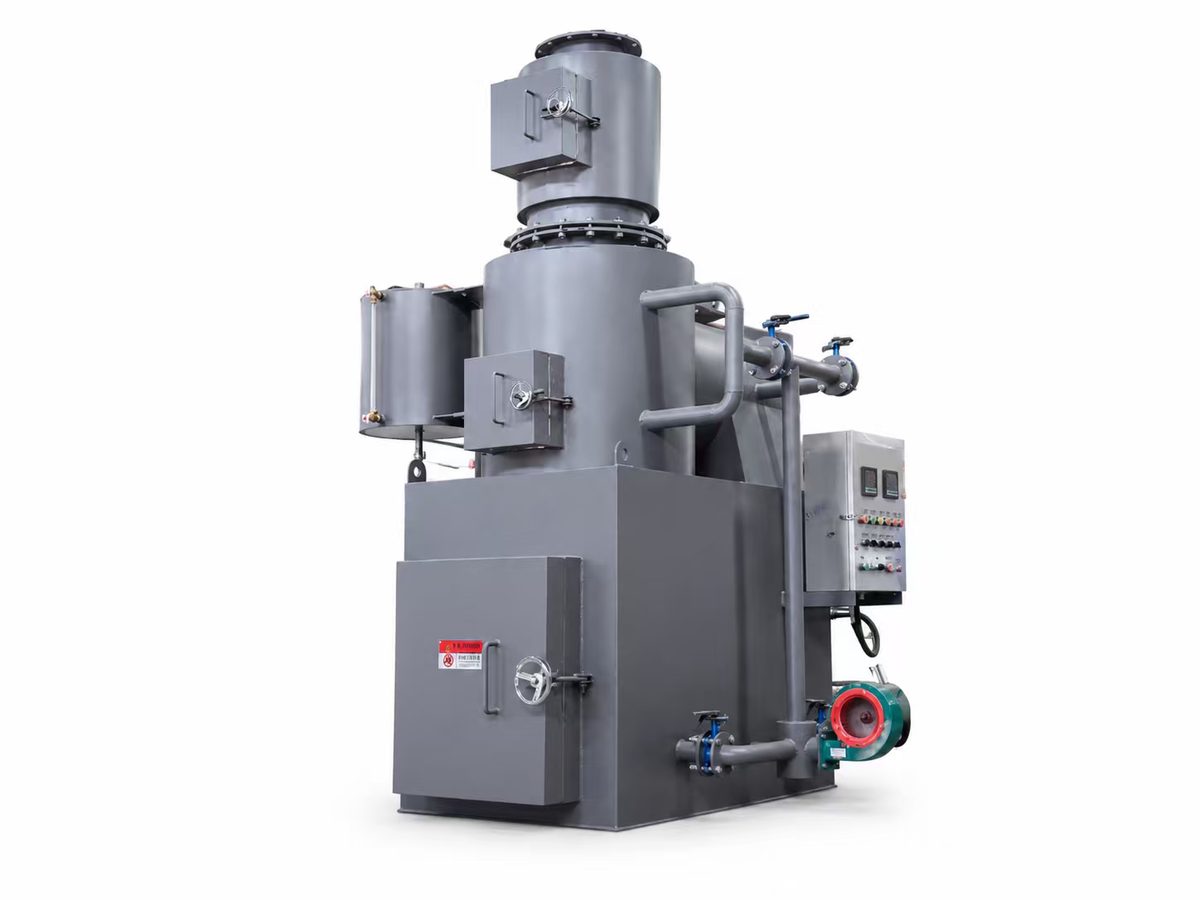
Capacity range
Model designation and exact dimensions depend on the configuration you choose — loading method, ash removal, and whether a gas cleaning train is included. The table shows the working range; we confirm a final specification after sizing.
| Model group | Capacity | Typical user | Daily waste covered | Loading |
|---|---|---|---|---|
| LDF-10 / 20 | 10–20 kg/h | Clinic, small hospital, laboratory | ~50–160 kg/day (8 h shift) | Manual |
| LDF-30 / 50 | 30–50 kg/h | District hospital, 100–300 beds | ~240–400 kg/day | Manual or ram |
| LDF-100 | 100 kg/h | Regional hospital, treatment centre | ~800 kg/day | Ram loader |
| XJY-200 / 300 | 200–300 kg/h | Centralised medical waste facility | ~1.6–2.4 t/day | Ram loader, continuous |
| XJY-500 | 500 kg/h | Municipal / provincial treatment plant | ~4 t/day | Continuous feed |
Daily figures assume an 8-hour operating shift at 80% load. Sizing rule of thumb for hospitals: 0.4 kg of medical waste per bed per day, then add a margin for peak days.
What the process data means
Two numbers matter more than any brochure photograph: the temperature in the secondary chamber, and how long the gas stays there.
- Secondary chamber 1100–1200 °C — held by an independent burner, after the primary chamber
- Gas residence ≥ 2.0 s — measured in the secondary chamber at operating temperature
- Destruction rate ≥ 99% — for the waste feed under design conditions
- Volume reduction up to 90% — ash residue typically 8–12% of feed by weight
- Primary chamber 800–900 °C — controlled combustion, reduced carry-over
Third-party emission testing can be arranged at commissioning. We provide the test report for the unit as built; we do not claim a type approval or certification for the equipment.
Scope of supply
| Standard | Two-chamber incinerator, burners, refractory lining, PLC control with temperature recording, ash doors, operation manual |
| Optional | Cyclone, heat exchanger, wet scrubber, baghouse with filter bags, ram loader, ash bin, chimney extension |
| Fuel | Diesel, LPG or natural gas — specify at order |
| Support | Foundation drawing, commissioning guidance, operator training material, remote troubleshooting |
If your unit has a baghouse, we supply the bags too
Incinerator flue gas is where filter bags fail fastest — acid, moisture and fine ash together. Buying the media from the same supplier as the equipment removes the argument about whose part caused the failure.
PPS with PTFE membrane
Up to 170 °C. The usual choice after a heat exchanger or dry scrubber, where the gas is acidic but not saturated.
PTFE felt
Up to 260 °C with near-universal chemical resistance. Where the gas is wet, hot, or the operating regime is unpredictable.
Viton diaphragms
The pulse valves on an incinerator baghouse see hot, acidic air. NBR diaphragms crack in weeks here.
Frequently asked
- How do I size a unit for my hospital?
- Count beds and multiply by 0.4 kg per bed per day, then add 30% margin for peak days. A 200-bed hospital produces roughly 80 kg/day, which fits a 20 kg/h unit on a single shift. Tell us the bed count and shift pattern and we will confirm.
- Does the incinerator need a gas cleaning system?
- For medical waste, yes — at minimum a secondary chamber, and normally a scrubber or baghouse downstream depending on local emission limits. We ask for the limits your authority applies before quoting, because they change the configuration and the price substantially.
- What fuel does it use and how much?
- Diesel, LPG or natural gas, with consumption depending on waste calorific value and moisture. Waste with high plastic content burns with little support fuel after warm-up; wet waste needs more.
- What about installation and commissioning?
- We supply foundation drawings, a piping and wiring schematic, and step-by-step commissioning guidance, plus remote support during start-up. If on-site attendance is required, say so at quotation stage so it can be priced in.
- Can you provide an emission test report?
- Yes — third-party testing at commissioning can be arranged and the report issued for the unit as built. We do not issue or imply a certificate of conformity for the equipment itself.
- What is the lead time?
- Typically 30–45 days for standard capacities, longer for units with a full gas cleaning train. Confirm at order.
Tell us the bed count and the waste
Daily waste weight, waste mix, available fuel and the emission limits you must meet. That is enough for a configuration and a price.